
Every Found It OS ships with its own set of books built in. It replaces QuickBooks. Here is why I built it.
A client's QuickBooks said her bank account was underwater.
Her real balance was healthy. Nobody typed the lie in — it grew, one unmatched month at a time, for years. And QuickBooks held the door open the whole way, because it gets paid the same whether your books are true or not.
We sat down with her actual bank statements and did the slow, honest thing:
The problem was never her. The problem was a product built to tolerate wrong books forever.
So I put QuickBooks on the bench and took it apart.
Underneath, ten parts and math that is seven hundred years old and still undefeated: double-entry. Every entry has two sides, the sides have to agree, the books check themselves. QuickBooks kept the math — then broke the one rule that made it worth anything: it lets anybody go back and edit history. I rebuilt all ten parts inside every Found It OS. It doesn't feed QuickBooks. It takes its place.
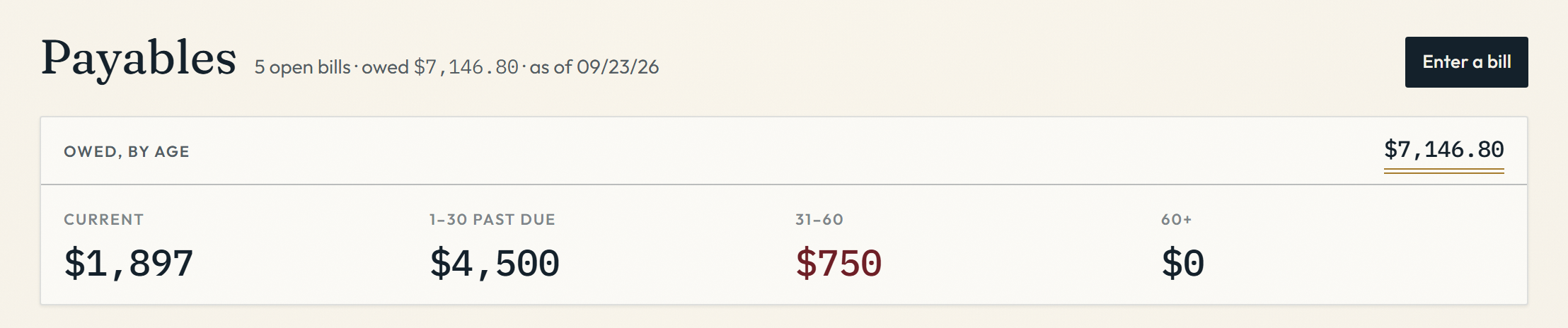
Every open bill, aged to the day. Behind the page, the ledger and the open bills are checked against each other, to the penny. That check is what would have caught her books the first month they drifted, not the fifth year.
In this ledger, history cannot be edited. By anybody.
Written is written — not me, not you, not an employee having a bad day, not the AI. Mistakes get fixed in the open, with a dated reversal. Your bank keeps its books this way. That is why you believe your statement.
The math proves itself, 134 different ways, on every change.
One test fails, nothing ships. Your old software asks you to take its word for it. Mine has to show its proof.
The AI files every transaction the moment it lands — fuel under fuel, insurance under insurance — so month-end is basically done and your accountant gets clean numbers instead of a shoebox. It files. It cannot touch history. And two things stay with humans forever: payroll and tax filing. We refuse to build those. Some work belongs to a person who signs her name to it.
🧠 For accountants with big brains — press here
Architecture. The ledger is an append-only event log with derived state. Journal entries are insert-only at the storage layer: a database trigger rejects UPDATE and DELETE outright, so immutability is a property of the database engine, not a promise kept by application code. No application code path, no user role, no AI privilege can rewrite a posted entry. The only mechanism of change is the compensating entry, your own reversing-entry discipline enforced as physics: the error and its reversal both stand, dated, in sequence. Banks book this way. Court dockets record this way. Software engineers call it event sourcing. Pacioli would call it a journal kept honestly. In audit language: the mutation history is complete and tamper-evident by construction. Existence and cutoff you still test. Completeness of the record you get for free, because mutation is unrepresentable to the application.
Invariants. Double-entry is treated as a type system, not a convention. The posting engine rejects any unbalanced entry at write time, so debits equal credits per entry, the trial balance foots by induction over the log, and the accounting identity holds at every point in history without waiting for a close. Balances, P&L, balance sheet, aging: all derived by folding over the ledger at read time. There is no stored aggregate to drift from the journal, so "books out of balance" is not an error we detect. It is a state that cannot be expressed.
Reconciliation as proof, not procedure. Control accounts re-tie to their subledgers on every render: A/P control is recomputed from the ledger and compared to the sum of open bills on each page load, so the green tie badge is an assertion that just executed, not a cached claim. Externally the books anchor to bank statements. The founding engagement reconstructed seven months of a general ledger solely from statements, each month closing to the printed balance exactly. Migration inherits the same epistemology: the new books run parallel with the incumbent, matched to the cent daily, and cutover belongs to the owner after sustained agreement, not to a sales calendar.
Verification. 134 tests encode the invariants: balanced postings, subledger tie-out through partial payment, full payment and void, overpayment rejection. Every code change re-runs all 134 before it ships; one failure blocks the release. "The math is right" is a continuous-integration artifact, not a marketing sentence.
The AI is a rights-limited producer. Classification sits strictly downstream: it files transactions to the chart, append-only, under the same trigger as every other writer, on a bounded write budget. Its worst case is a visible, reversible miscategorization. Corrupted history is not in its capability set. Payroll and tax filing are excluded permanently; work that carries a licensed signature stays with the person who signs.
Mechanism design. Rented accounting software collects the same subscription whether your books are true or false, so nothing in its architecture forces truth: an editable past, an optional closing-date lock, an audit log that records the rewrite instead of refusing it. This engine inverts the incentive by construction. A pure, dependency-light library vendored into a system the client owns outright, code and data, where an untrue book is either a rejected write or a visible reversal. Pacioli handed us self-checking notation seven hundred years ago. The industry broke it with an edit button. We took the edit button away.
Nothing gets ripped out on day one.
The new books run beside your QuickBooks, matched to the penny, until you say go — on your clock, not a salesman's. And the ledger is yours: code, data, every number, the same way the cash in your drawer is. Nobody rents you your own business back.
One last thing, in writing.
The next set of books we tore up was our own. Update, August 30: we kept the promise, and the first thing our own books caught was a $99,000 hole in QuickBooks' July. The full report is here.
I'm Trevor. Found It Software, Alexandria, Louisiana.
The story is real and the client stays anonymous. Every screen shown of this engine runs demo data, every name and dollar on it invented. No client information, ever.